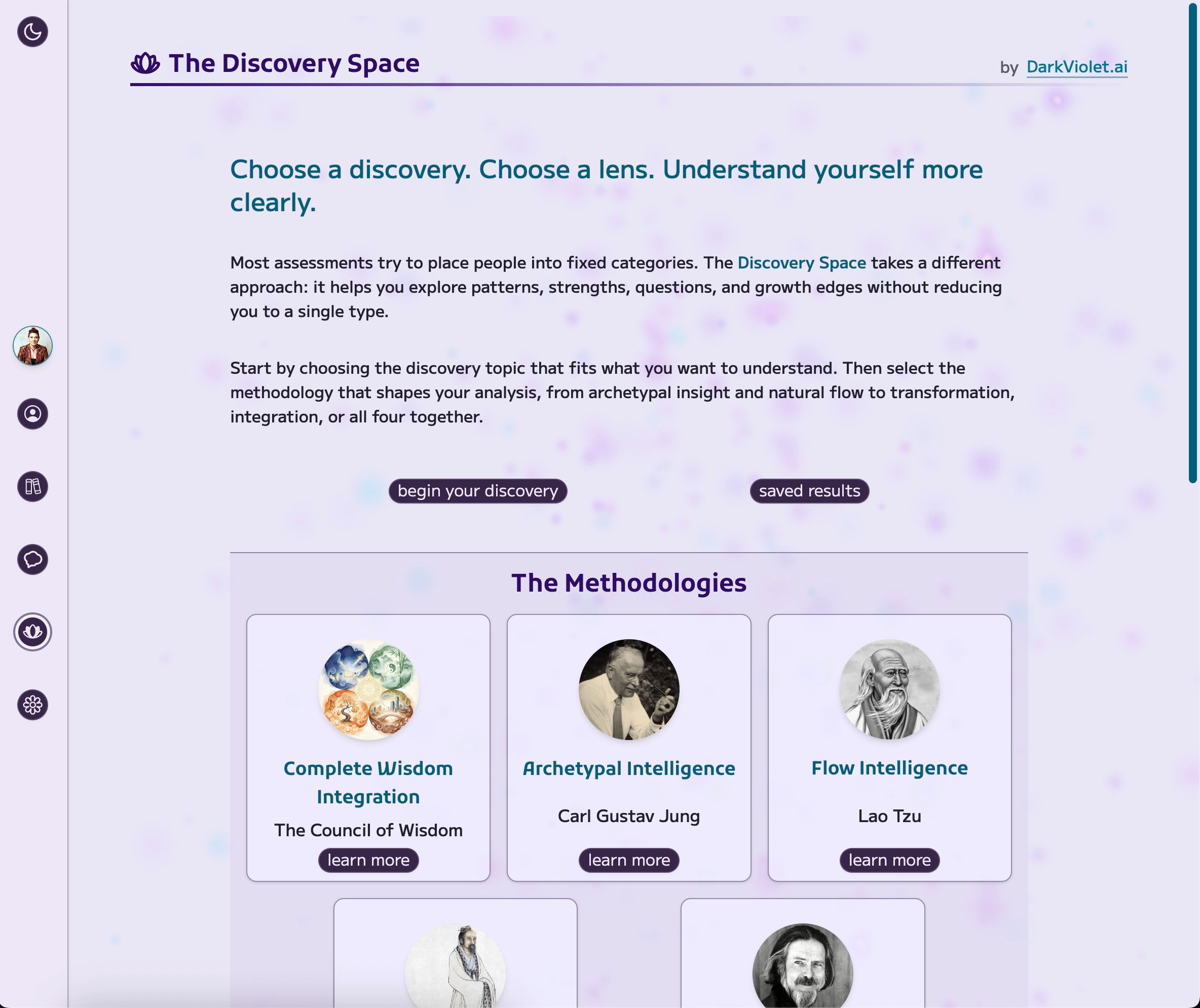
The Discovery Space: Guided Self-Discovery Through Ancient Wisdom
The Discovery Space
A close look at what guided self-discovery actually means when the wisdom doing the guiding comes from Carl Jung, Lao Tzu, Zhuangzi, and Alan Watts.
Most self-assessment tools have a quiet assumption baked in: that the goal is to sort you into a category. You answer the questions, you get a type, and the type is supposed to explain something about you. Some of those tools are genuinely useful. Many of them are not, and the reason they fall flat is not the questions. It is the frame. When the system is only trying to place you, the result tells you what box you fit rather than what is actually happening inside you.
The Discovery Space starts from a different premise. The goal is reflection, not classification. You are not trying to find out what type you are. You are trying to understand a specific thing about yourself at a specific moment, with a specific kind of intelligence helping you look.
That shift in purpose changes everything about how the experience feels. The questions are focused on real patterns from your actual life. The analysis reads like insight rather than a report. And the methodology you choose means the same set of honest answers produces genuinely different results depending on which lens you choose to view yourself through.
The Methodology Layer
This is the architectural decision that makes The Discovery Space so special. Every other reflective assessment tool I have used has a single analytical framework underneath it, usually something loosely behavioral or psychological, and it applies that framework uniformly to every user and every question. In my experience this makes them essentially no more in depth than a magazine personality test from back in the day. You just receive whatever interpretation the system was built to produce.
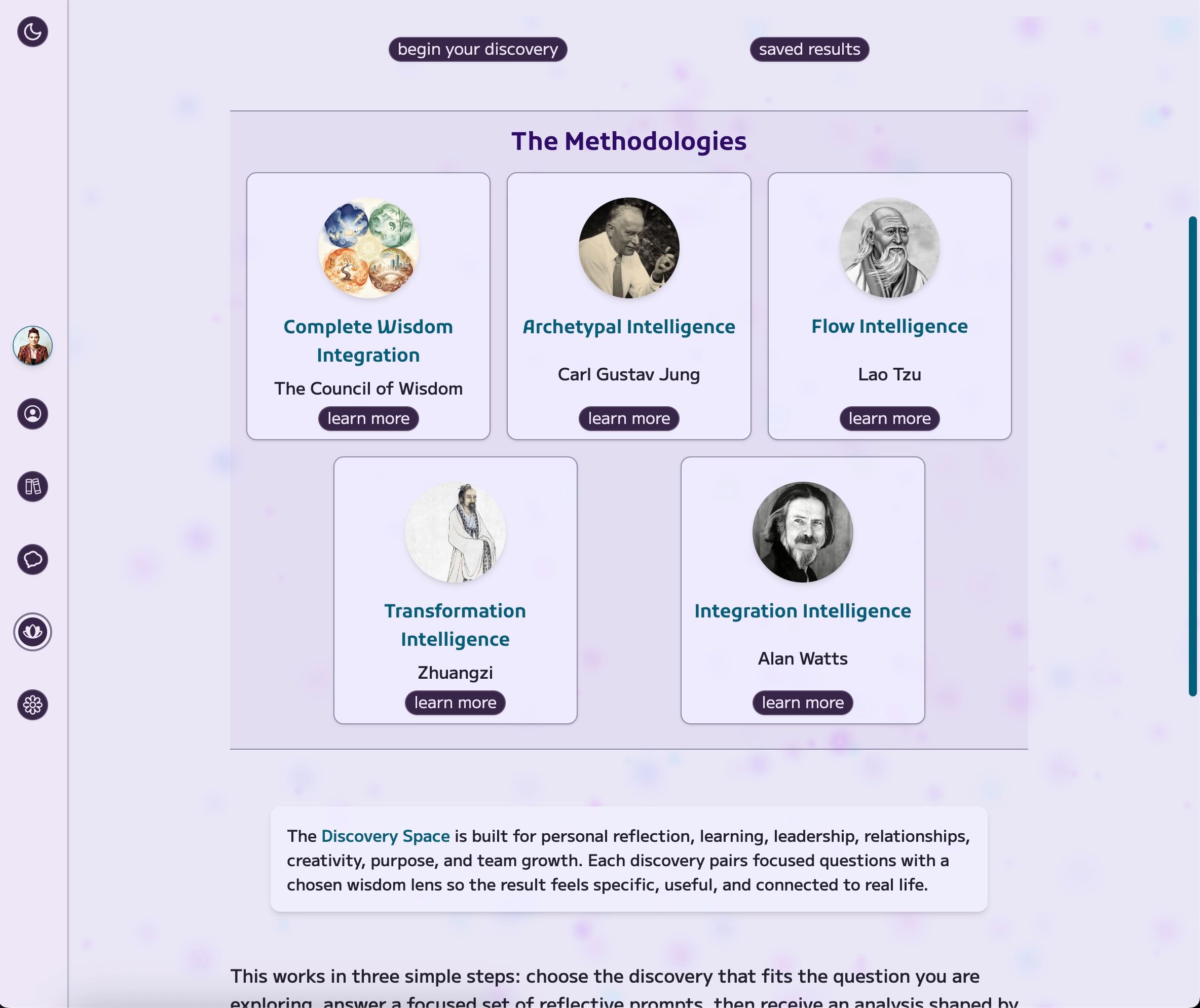
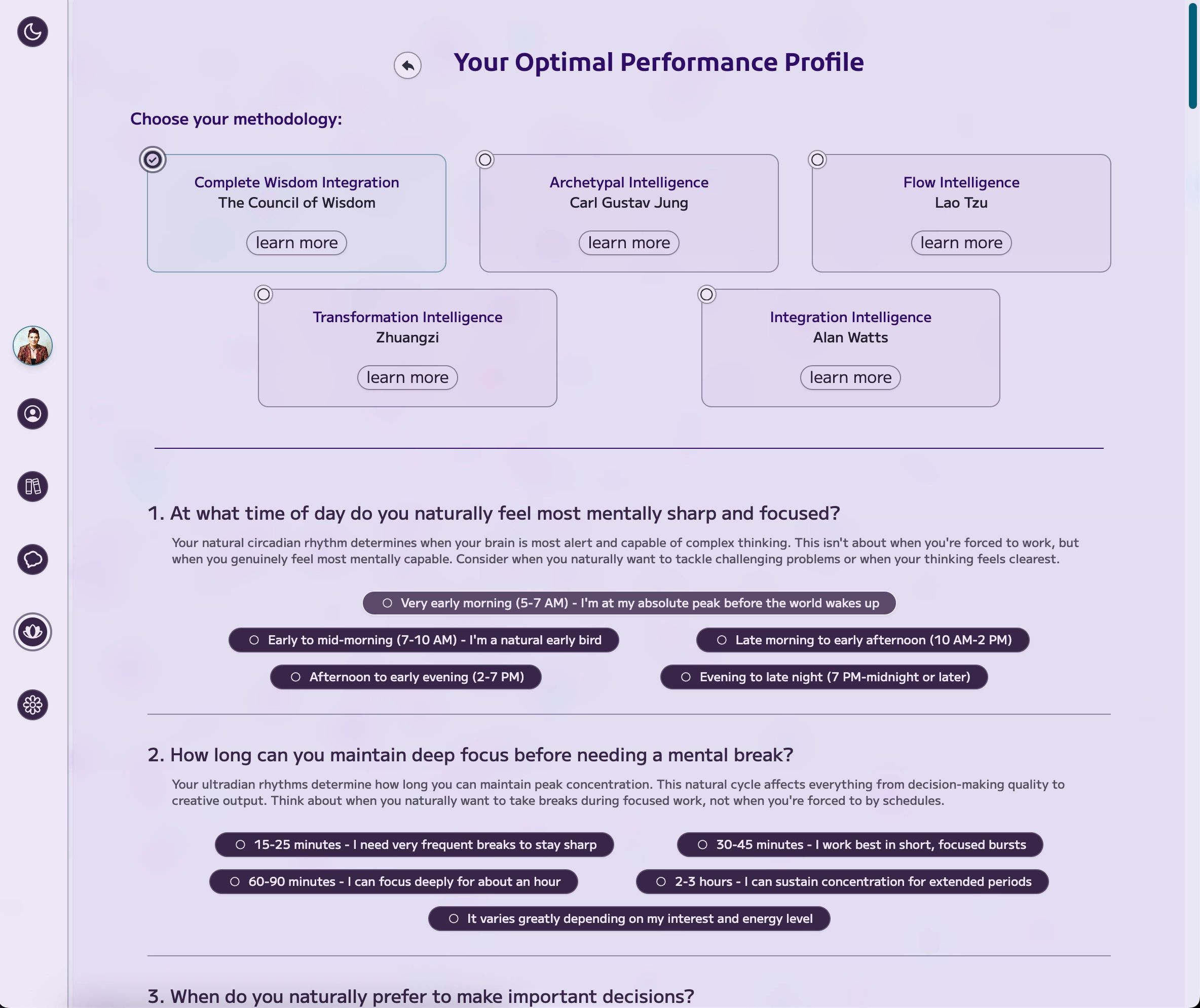
The Discovery Space gives the user so much more than a personality assessment. There are four options, five if you count the Complete Wisdom Integration option, each drawn from a distinct intellectual tradition.
- Archetypal Intelligence, drawn from Carl Jung, looks at recurring patterns in your identity, the figures and forces that show up consistently across your history and behavior.
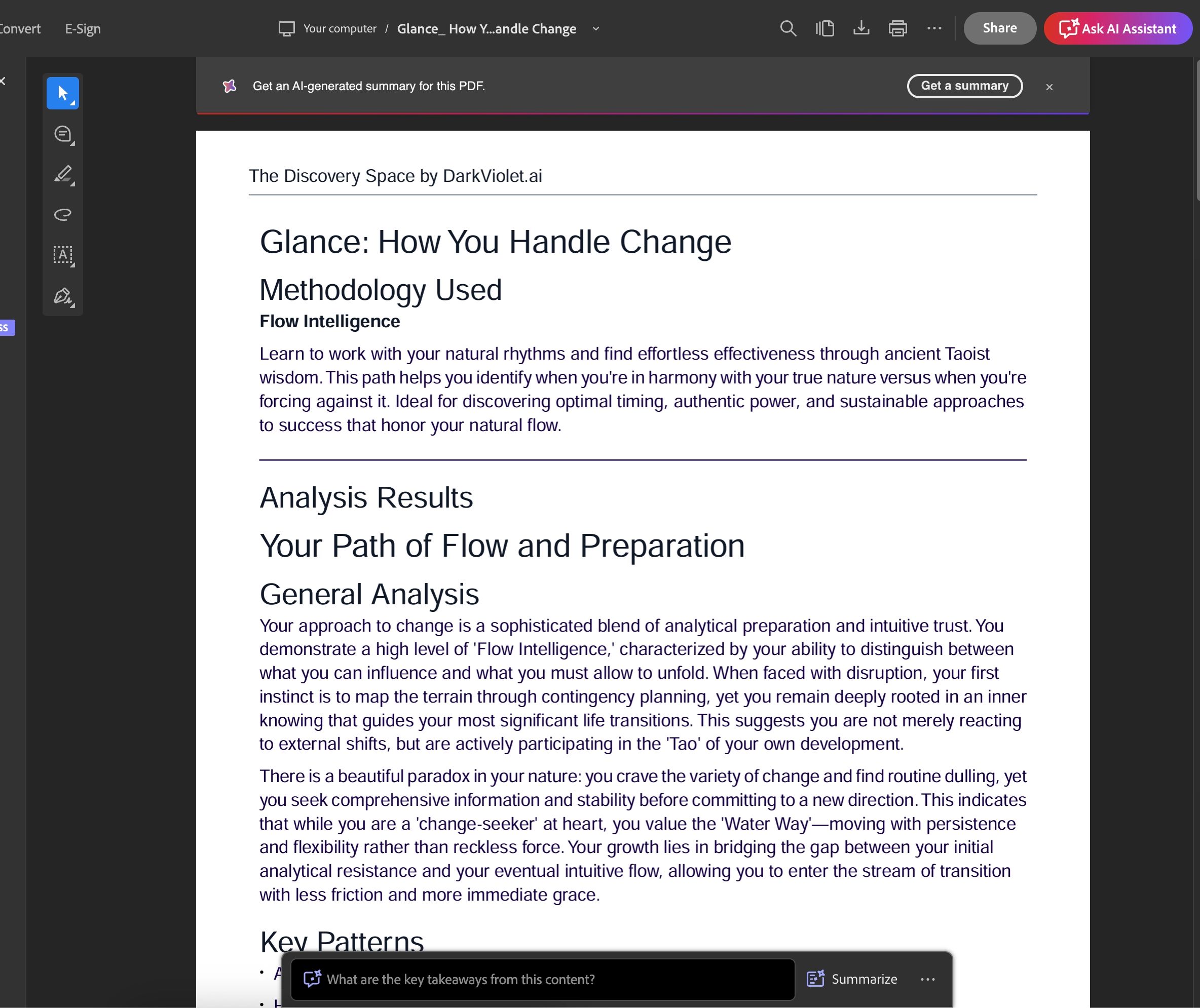
- Flow Intelligence, drawn from Lao Tzu, focuses on timing, natural energy, and where resistance versus ease live in the way you operate.
- Transformation Intelligence, drawn from Zhuangzi, explores adaptability, perspective shifts, and the creative possibilities that open when nothing is fixed.
- Integration Intelligence, drawn from Alan Watts, works at the edges between inner life and outer world, bridging insight with real relationships, work, and modern complexity.
Each of these is a genuinely different way of reading a person. Choose Archetypal Intelligence for a discovery about your leadership style and you get an analysis built around inner patterns, symbolic roles, and the deeper story driving your behavior. Choose Integration Intelligence for the same discovery and you get something oriented toward how your leadership actually lands in practice, in relationships, in the systems you move through. The questions are the same. The lens is different. The result lands somewhere entirely its own.
The Council of Wisdom
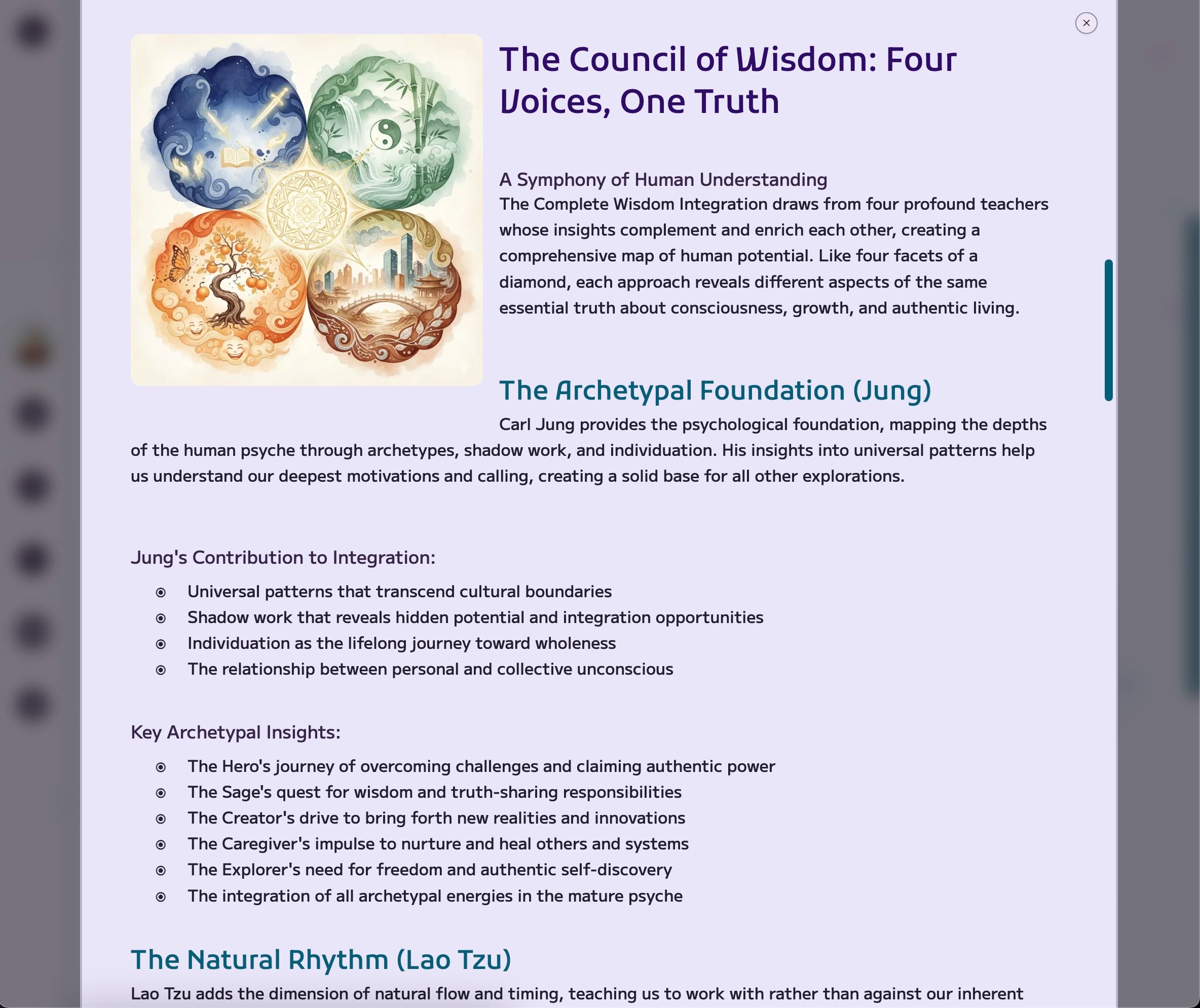
For users who want more than a single perspective, there is a fifth option: Complete Wisdom Integration. This is the Council of Wisdom, and it runs all four methodologies against your responses and weaves them into a unified analysis.
What you get back is something no single lens can produce. Jung might surface an archetypal tension in your pattern. Lao Tzu might read that same tension as an energy drain rather than a symbolic conflict. Watts might show you where both of those readings connect to a relationship or a practical situation in your daily life. Zhuangzi might reframe the whole thing as an invitation to shift perspective entirely. None of those readings cancels the others. Together they produce a picture of genuine complexity, which is the only kind of picture that accurately reflects a real person.
The Council of Wisdom option takes longer to generate because it is doing more work. For the right question and the right moment, that extra depth is worth it.
The Discovery Library
The library of available assessments is broad enough to be useful across most of the questions people actually carry around. The topics cover core identity and purpose, optimal performance, change and innovation, systems integration, blind spots and hidden strengths, relationship dynamics, creative intelligence, leadership style, learning and development, communication style, life purpose and meaning, stress and resilience, decision-making, energy management, conflict resolution, innovation and problem-solving, knowledge integration and mentoring, financial psychology, life phase and transition, digital wellness, authentic self and core values, and global impact and social contribution.
That is a wide range, and the width is intentional. Self-understanding is not a single topic. Someone might come to the platform because they are in the middle of a career transition and want to think about purpose. Someone else might be managing a team and want to understand their leadership patterns more honestly. A third person might be feeling creatively blocked and want to understand what is actually happening. Each of those is a different question, and the library is built to meet people where the question actually lives.
Several of the fuller assessments are currently in development, with the core set fully live. I am always adding to the platform.
Glances: A Shorter Entry Point
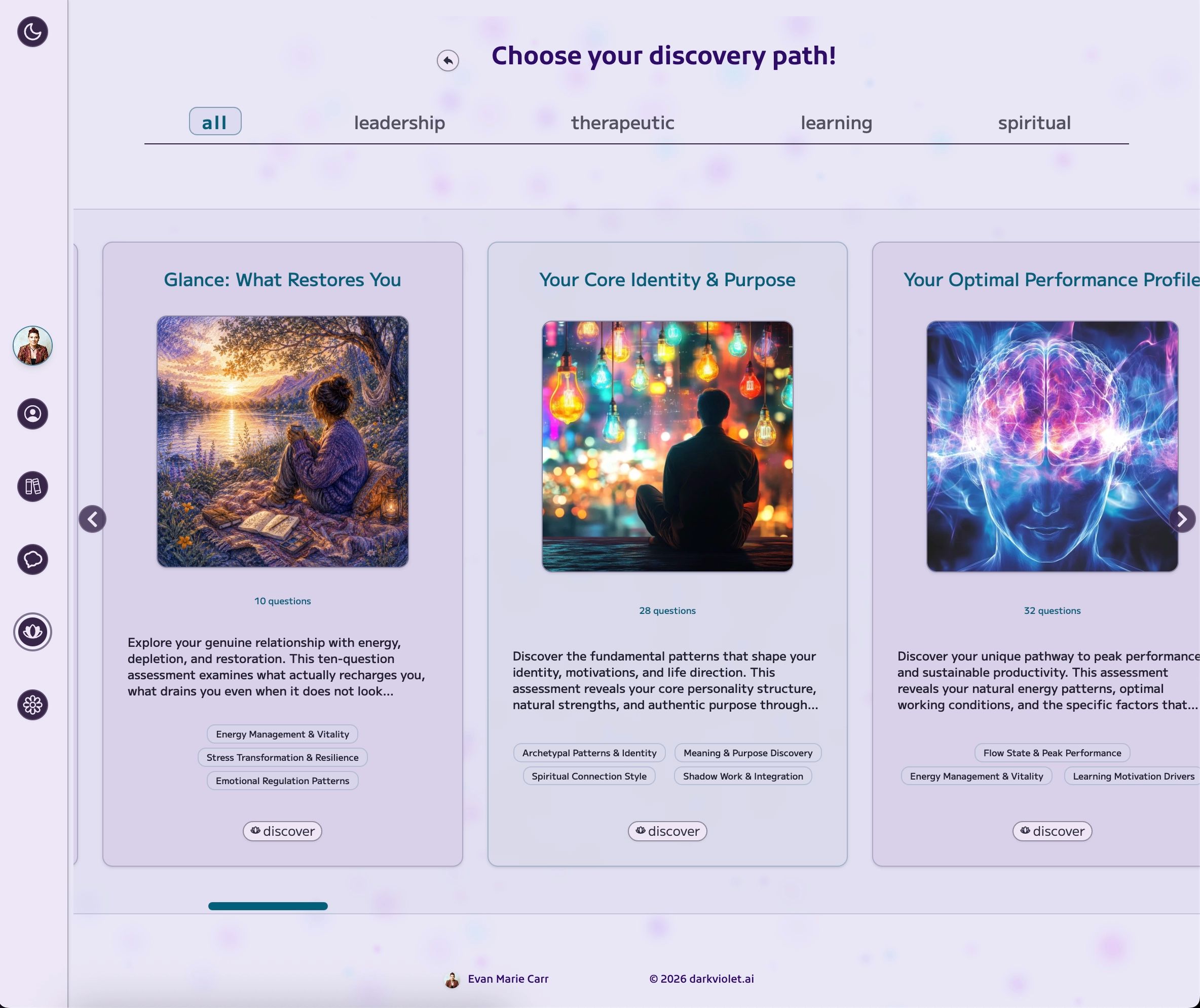
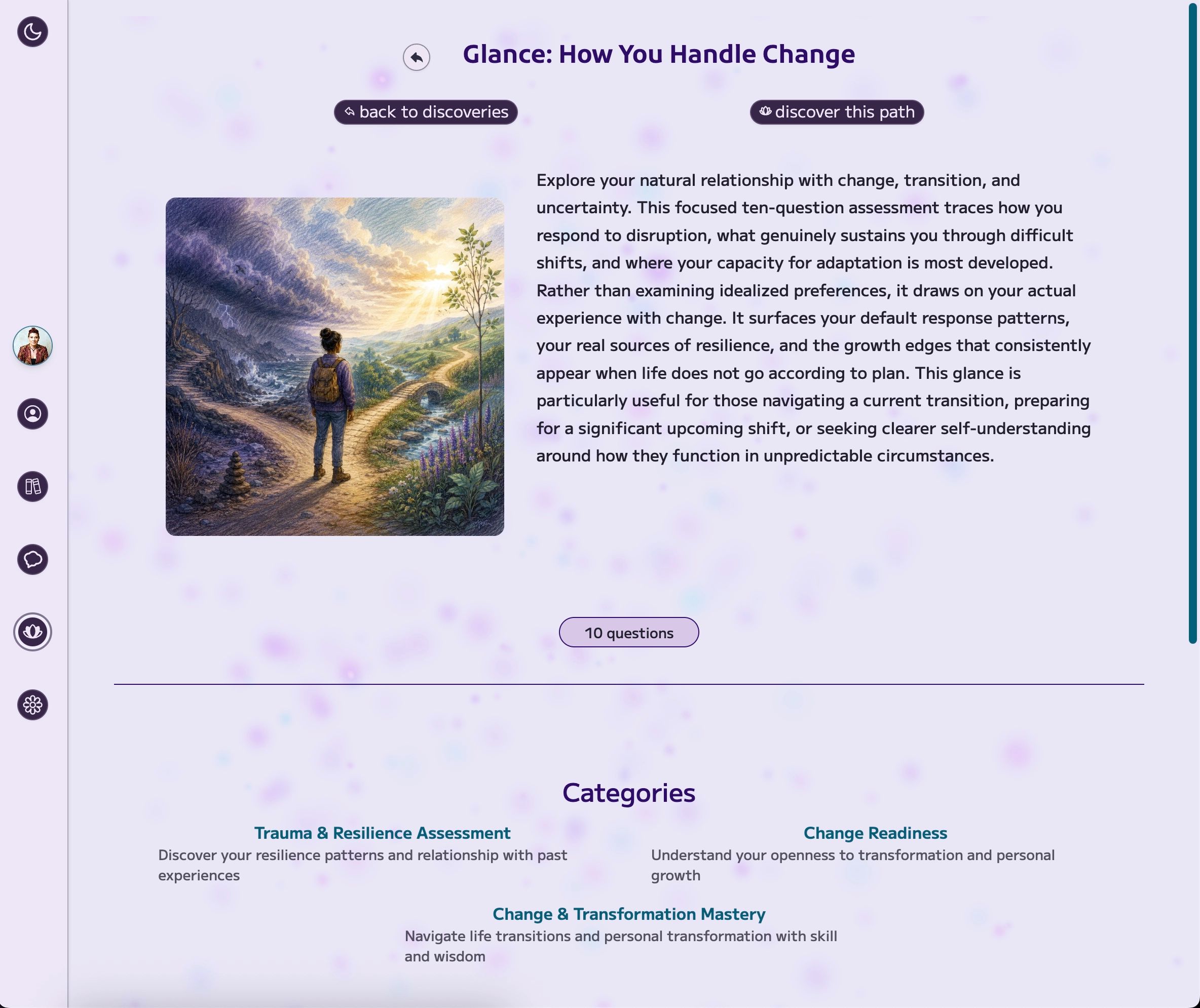
Not every question deserves a thirty-question deep dive. Sometimes you want a focused look at one specific thing, without the time commitment of a full assessment. The Glances format exists for exactly that.
Each Glance is ten questions built around a tightly scoped topic. The current four cover how you handle change, your creative nature, how you make decisions, and what genuinely restores you. These are not simplified versions of the fuller assessments. They are purpose-built for their scope, designed to surface honest patterns in a shorter session.
The Glance on what restores you is a good example of what makes the format work. The framing is specific from the start: this is about what actually recharges you, not what you think should or the advice you have received. The questions are designed to bypass the idealized self-presentation most people default to and get at the real patterns. Ten questions is enough to do that when the questions are right.
For people new to the platform, starting with a Glance is a natural way in. You get a complete experience with a genuine result in a short session, and you can decide from there whether you want to go deeper.
The Question Experience
So what about the questions themselves? They are where the experience either earns trust or loses it. A reflective assessment is only as good as the reflection it inspires. If the questions are generic, the answers are generic, and the analysis that comes back reflects that.
The questions in The Discovery Space are written to push past the idealized version of yourself you might present on a standard questionnaire. They ask about your actual experience, the real patterns that have shown up across your history, not your preferences in the abstract. The question on how you handle change does not ask whether you like change. It asks how you have actually responded to disruption, what has sustained you, and where your adaptation capacity genuinely runs out.
That specificity matters because it produces responses with real content for the system's analysis engine to work with. The more honest and concrete the answers, the more precise the result. The platform cannot enforce honesty, but the design of the questions creates conditions where honest answers come more naturally than performed ones. It makes the experience of answering honestly rewarding rather than burdensome.
The Discovery Space Analysis
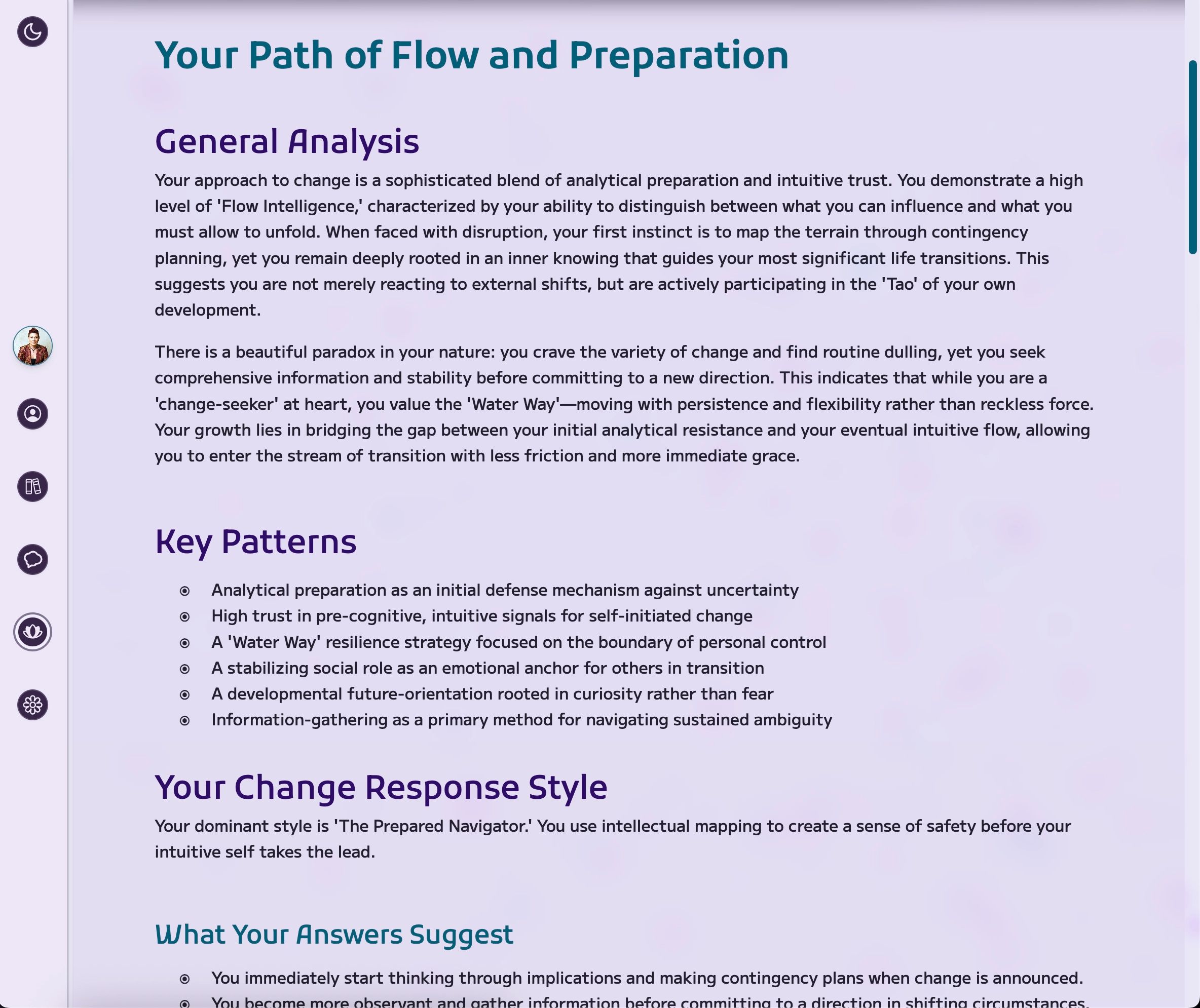
When the questions are complete, the analysis engine generates a reflection shaped entirely by the methodology selected. This is where the choice of lens shows up most visibly.
The analysis reads nothing like a personality report. There are no type labels, no percentile scores, no radar charts. What comes back is a piece of writing. It references what you actually said. It surfaces patterns across your answers. It reflects them back through the particular frame of whatever methodology you chose, whether that is Jungian archetypal tension, Taoist energy flow, Zhuangzi's perspective-shifting, or Watts's integration across life dimensions.
The most striking thing about the results, in my experience, is the specificity. It does not feel like it was generated for someone generally similar to you. It opens a window into your actual experience. That specificity is the difference between an insight and a horoscope, and it comes from the combination of targeted questions and a methodology that actually has something substantive to say about human experience and about you.
Complete Wisdom Integration in Practice
Seeing a Council of Wisdom result makes the single-methodology results easier to understand by contrast. Where a Jung analysis might spend significant space on recurring inner figures and the tension between different archetypal drives, a Council result will include that reading alongside a Taoist observation about where resistance lives in your energy, a Zhuangzi reframe of a pattern that has felt fixed, and a Watts-shaped reflection on how the whole picture connects to your relationships and daily context.
The synthesis is much more than the sum of four analyses stacked together. The platform is looking for the places where the perspectives converge and the places where they productively diverge, and it surfaces both. When three lenses name the same pattern in different language, that convergence has weight. When the lenses pull in different directions, that tension is often the most interesting part of the result.
For questions that involve genuine complexity, career transitions, relationship dynamics, questions about purpose, the Council of Wisdom option tends to produce results that feel proportionate to that complexity. For a more focused question with a clearer scope, a single lens often lands with more precision.
Saved Results
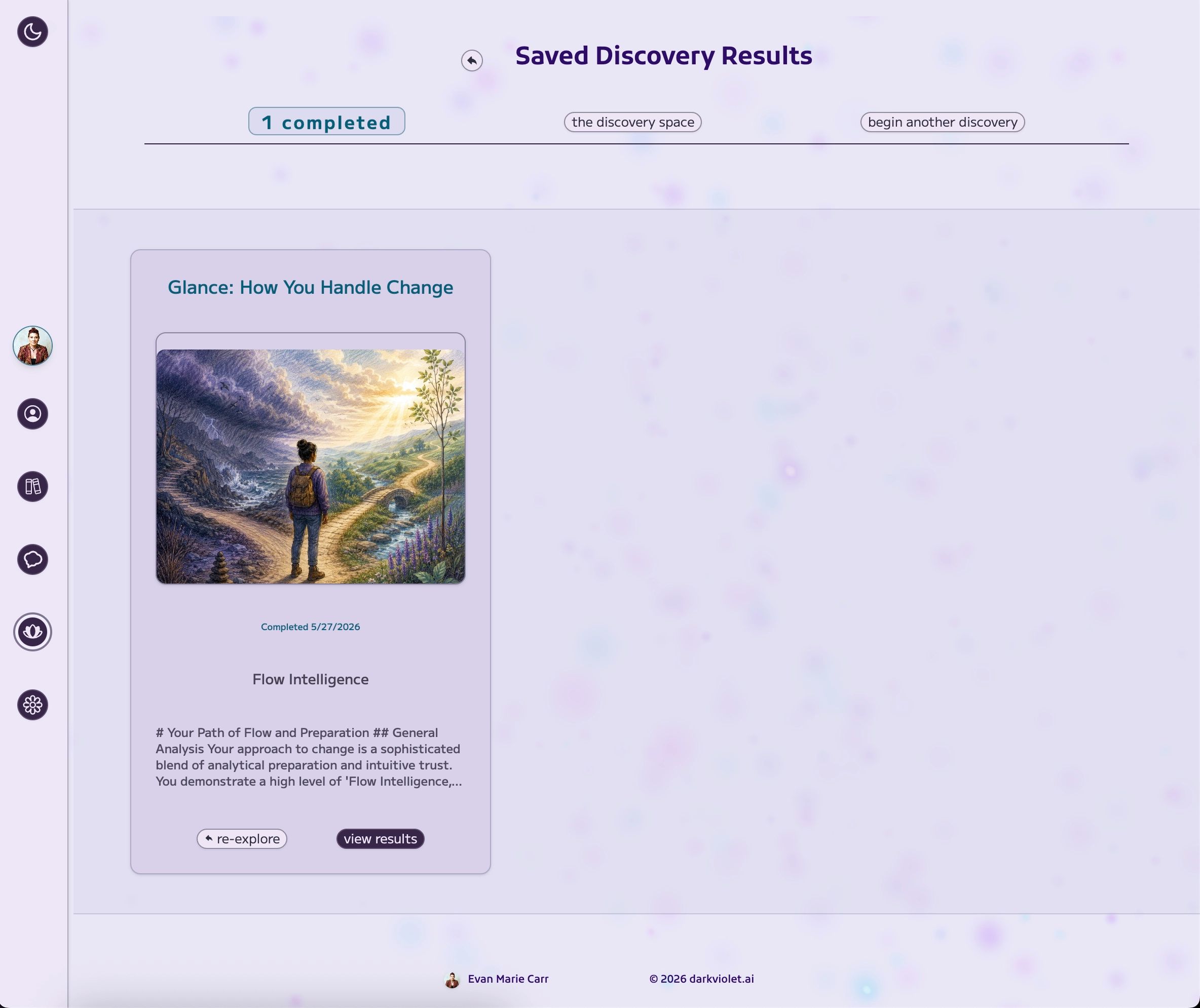
The platform saves results so you can return to them. This is a small feature that carries more value than it might seem at first.
Self-discovery is not a single event. The same question explored six months apart produces different answers, and comparing those answers over time tells you something that neither result could tell you alone. You can see which patterns are genuinely stable and which ones shift with circumstance. You can notice when your relationship with a question has changed, not because you learned the right answer but because something in your actual life moved.
Saved results also support a different kind of use: returning to a result a few days after the session rather than immediately. Just download the PDF version of your result and you can return to it later. The analysis often reads differently once the initial experience of reflecting on and answering the questions has settled. Details that seemed peripheral on first read land differently when you come back with some distance.
The Use Cases That Work Best
The Discovery Space is built for personal reflection, leadership development, learning support, relationship insight, creative direction, and team growth. Each of those works, and I have seen most of them in practice.
Personal reflection is probably the most common use, and also the most forgiving. You bring a question that has been sitting with you, you spend twenty minutes on an assessment, and you get a result that articulates something you had a sense of but had not quite put into words. That articulation is the value. It is not giving you information you did not have. It is giving you language and structure for something that was already there but that you might not have been able to quite see before.
Leadership development is where the methodology choice matters most. Leaders asking about their style through a Jungian lens get a very different analysis than the same leaders asking through an Integration lens. The first reads in the direction of inner pattern and symbolic role. The second reads in the direction of practical impact on the people around you. Both are useful. They are useful for different purposes, and being able to choose which angle to take is genuinely valuable for someone doing serious development work.
Creative blocks respond particularly well to the Zhuangzi lens, in my experience. The Transformation Intelligence framework is built around the idea that apparent stuckness is often a perspective problem rather than a capability problem, and a Zhuangzi-shaped analysis of a creative question tends to open things up rather than diagnose them.
When the Work Becomes Professional
Everything described so far works for a single person sitting with a single question. But the same architecture turns out to be just as useful when the person asking is responsible for other people. Over time I have watched The Discovery Space get used well beyond individual reflection, and the patterns are consistent enough to name.
For people leaders and managers, the value is in understanding how the people around them actually think, decide, and operate, rather than guessing. A discovery run through a chosen lens gives a manager language for a direct report's working style that is more honest, and more humane, than the usual shorthand. For HR and people teams, the platform fits the places where reflection already belongs: onboarding, development conversations, role fit, and the ongoing work of building a culture people actually want to be part of. It is non-diagnostic and it is genuinely pleasant to complete, which matters more than it sounds when you are asking a whole team to engage with something.
Coaches, therapists, and educators use it differently again, as a structured starting point. A client or a learner arrives with a result already in hand, which means the first conversation starts somewhere real instead of starting cold.
I want to be careful about the framing here, because this is exactly the kind of tool that gets misused when the framing slips. Every discovery is reflective and developmental. It is built for growth and conversation, as one meaningful input among many. It is not a clinical instrument and it is not a hiring gate, and I have designed both the language and the use cases to keep it on the right side of that line.
Custom Discoveries and Custom Methodologies
The library covers a wide range of questions, but no fixed library can anticipate the specific question a particular team or organization is actually carrying. So the platform now supports two kinds of custom work, and they map onto the two layers that make The Discovery Space what it is.
A custom discovery is a tailored set of questions built around a specific goal: onboarding and culture-fit reflections tuned to a set of values, leadership and succession-readiness work, team dynamics and communication, role-specific discoveries for hiring and internal mobility, or a cohort experience designed for an offsite or a workshop. The topic is shaped to the situation, and it can be white-labeled to fit an organization's brand and language.
A custom methodology works on the deeper layer. Instead of choosing among Jung, Lao Tzu, Zhuangzi, and Watts, an organization can have a wisdom lens built around its own leadership model, its competency framework, or its stated values, so the analysis speaks in language the organization already uses. It can also be drawn from a particular tradition or thinker that matters to the people involved, or blended for a specific role or initiative. This is the part I find most interesting, because it takes the core idea of the platform, that the lens changes everything, and points it at a framework someone already cares about.
Both kinds of request start the same way, through a contact form built specifically for The Discovery Space rather than a generic inbox. You say what you are hoping to understand, for whom, and on roughly what timeline, and the conversation goes from there. The same honesty that makes the questions work applies here too: the more specific the goal, the better the result.
What Makes This Different
The most common feedback I have heard about The Discovery Space is that the results feel incredibly personal, enlightening, and insightful.
This comes from three main pillars of The Discovery Space working together. The questions are targeted and honest enough that the answers have real content. The methodology system means the analysis is shaped by a genuine intellectual framework with something substantive to say, not a generic psychological vocabulary applied uniformly. And the analysis engine is working from both of those inputs to produce something that reflects the actual intersection of that person's answers and that particular wisdom tradition.
No assessment tool is a substitute for serious therapeutic work, coaching, or the kind of understanding that comes from long-term self-reflection. The Discovery Space does not try to be. What it does well is create a structured entry point for reflection that a lot of people would not otherwise have, give that reflection genuine intellectual substance, and return something worth sitting with.
For a certain kind of question at a certain kind of moment, that is exactly the right thing to have available.
Quick Reference: How to Use It
For anyone coming to the platform for the first time: start with a Glance if you want a quick introduction to how the experience works. The ten-question format gives you a complete result without a large time commitment, and it helps you understand the difference between methodologies before you choose one for a fuller assessment.
When you are ready for a full discovery, bring a real question. The platform works best when you are genuinely curious about something rather than just browsing. Pick the discovery topic that fits the question most closely, then choose the methodology that matches how you want to look at it. If you are not sure, the Council of Wisdom will show you how all four lenses see the same material.
Answer honestly. The design of the questions makes this easier than it sounds, because they are asking about real patterns from your actual experience rather than your preferences or ideals. You do not need to present yourself well. You just need to say what is true. Some of the most important work The Discovery Space guides you through happens in those moments of sitting with a question before you answer it.
Save the result and return to it later. The analysis will still be there, and it will likely read differently the second time. That difference is often where the most useful insight lives.