
AI for Learning: Amplifying the Way We Learn and Teach
AI for Learning
This is something I care about more than almost anything else I work on, so let me think out loud for a minute. When it comes to learning, what is AI actually for? After sitting with the question for a long while, I keep landing on the same word: amplification. The kind of AI I believe in is human-centered, which is a plain way of saying it works to make us sharper and more engaged rather than to think on our behalf. Used that way, it can help us learn more deeply and teach each other better, which might be the most genuinely human thing we have ever asked a machine to do.
The conversation around AI keeps splitting into two loud camps. One side is giddy, sure that machines will soon handle everything for us, our thinking included. The other is braced for disaster, warning that we are about to outsource our brains and forget how to think at all. I find both a little exhausting, and both of them sail right past the more interesting path, which is the part I actually want to talk about.
What if we looked at it this way? A tool is only as good as the human using it. And now that we have machines that can do so much, it is of the utmost importance that we think deeply about the jobs we give to them. Give a calculator your reasoning and you end up unable to estimate a tip. Give it your arithmetic and you free yourself to reason about bigger things.
AI sits in that same spot, except the stakes feel higher, because the thing we might be tempted to hand over is thought itself. So here we must strike a perfect balance and commit to an honor system of accountability for using AI to always better ourselves and never to outsource the role of the human.

Amplification, Not Replacement
Here is the line I try to hold onto. AI should amplify what a person can do and never quietly take over the part that makes us who we are. The thinking, the remembering, the slightly uncomfortable wrestle with a hard idea, all of that belongs to the learner. The machine can carry the rest.
That distinction sounds small, but it changes everything. A tool built to do the work for you produces a human who finishes something but learns nothing. A tool built to support the human produces understanding that actually sticks around and enhances the life experience of the person using the tool. Both the little demo I will walk you through and the larger platform behind it are built on that one rule, and you will see it show up in concrete ways as we go.

Learning Can Be Hard for Imaginative Minds
I know I am not the only one who has done this. I have finished entire pages of books or articles and then realized immediately afterward that I couldn't remember any of it. My eyes moved across every word. My brain, apparently, had other plans. For a long time I would beat myself up about it a bit, seeing it as a little bit of a personal failing. I would make myself read out loud as a child, for example, to make sure I was actually paying attention to what my brain was reading. I was never bad at reading or reading comprehension. I just have an imaginative brain, and it likes to multitask.
It took me a while to see that the format was working against me. We built our whole information diet around delivery. Someone packages an idea into a video or a PDF, drops it in front of us for us to learn, and we call the transaction complete. The trouble is that exposure and understanding are not the same thing, and pretending otherwise has left a lot of smart, curious people feeling vaguely dim. Funny how that works. The problem was never us.

From Consuming to Doing
What we know about memory is almost stubbornly simple. We hold onto the things we have to reach for, things we play with, immerse ourselves in, and interact with. Retrieval, self-testing, noticing the gaps in our own understanding, returning to the source with a sharper question, these are the moves that turn information into knowledge. None of them happen while we sit still and attempt to just absorb content passively.
This is where AI earns its keep. It can take a flat piece of source material and reshape it into something we move through actively, one idea at a time, at our own pace. The reading becomes a conversation instead of a monologue. Let me show you what that looks like in practice, because I would rather show it to you at work than just describe a concept.
You Can Try It Yourself
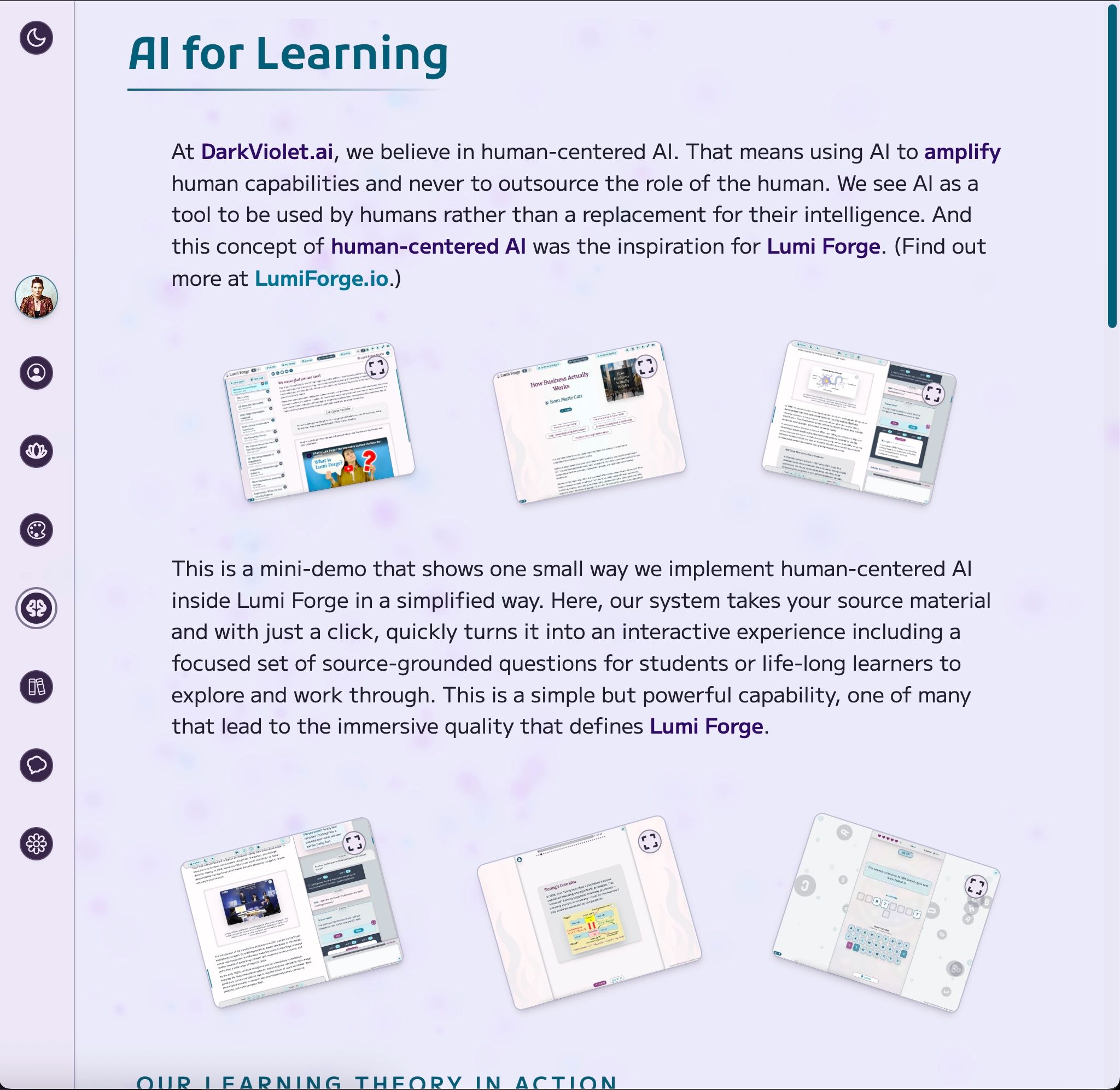
If you would rather feel the difference than read about it, I built a small demo you can try right now. It lives on DarkViolet.ai, it is called AI for Learning, and it is another great example of human-centered AI that I have built that you can play with yourself. It follows the amplification rule in the most literal way I could manage. It begins with your material, not mine and not the model's. You upload a PDF or paste in some text, and the system does the rest.
Starting from your own source is a very important part. The interactions you are about to get come straight from the words you handed over, not from some vague training soup the model half-remembers. That is what makes them worth your time. You can use this system to learn and test yourself or another person about any content you want to upload.
Shaping the Practice
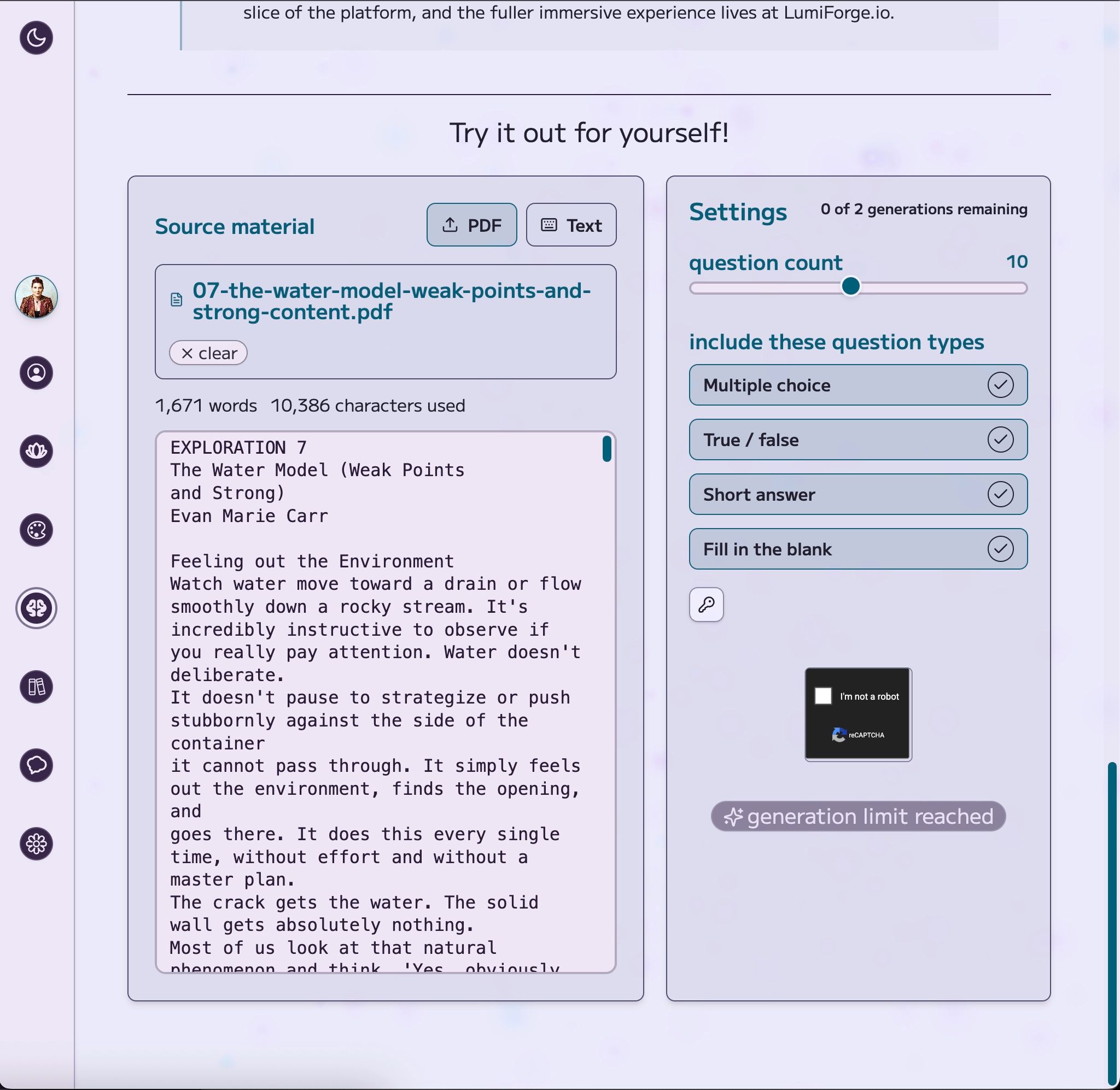
You get to decide the shape of the practice. You choose how many questions you want based on your content, and you pick which kinds to include from four types: multiple choice, true or false, short answer, and fill in the blank. The demo then balances the set across whatever you selected, giving you a fairly balanced set of questions of all types selected.
Each type asks something different of your brain, which is the whole reason to offer more than one. Multiple choice makes you weigh options and notice nuance. True or false is a fast gut check. Fill in the blank forces you to pull a word out of memory rather than simply recognize it, which is harder and far better for holding on. Short answer goes deepest, because explaining an idea in your own words is the moment you find out whether you truly understand it.
Grounded In Your Own Truth
There is a failure mode with AI that worries me, and it is what others often mention to me when the subject of AI for learning comes up. The model wanders off, invents a lesson loosely related to your material, and hands you a confident little falsehood with a perfectly straight face. In a learning tool, that behavior does real harm, because it teaches you something either unintended or possibly false.
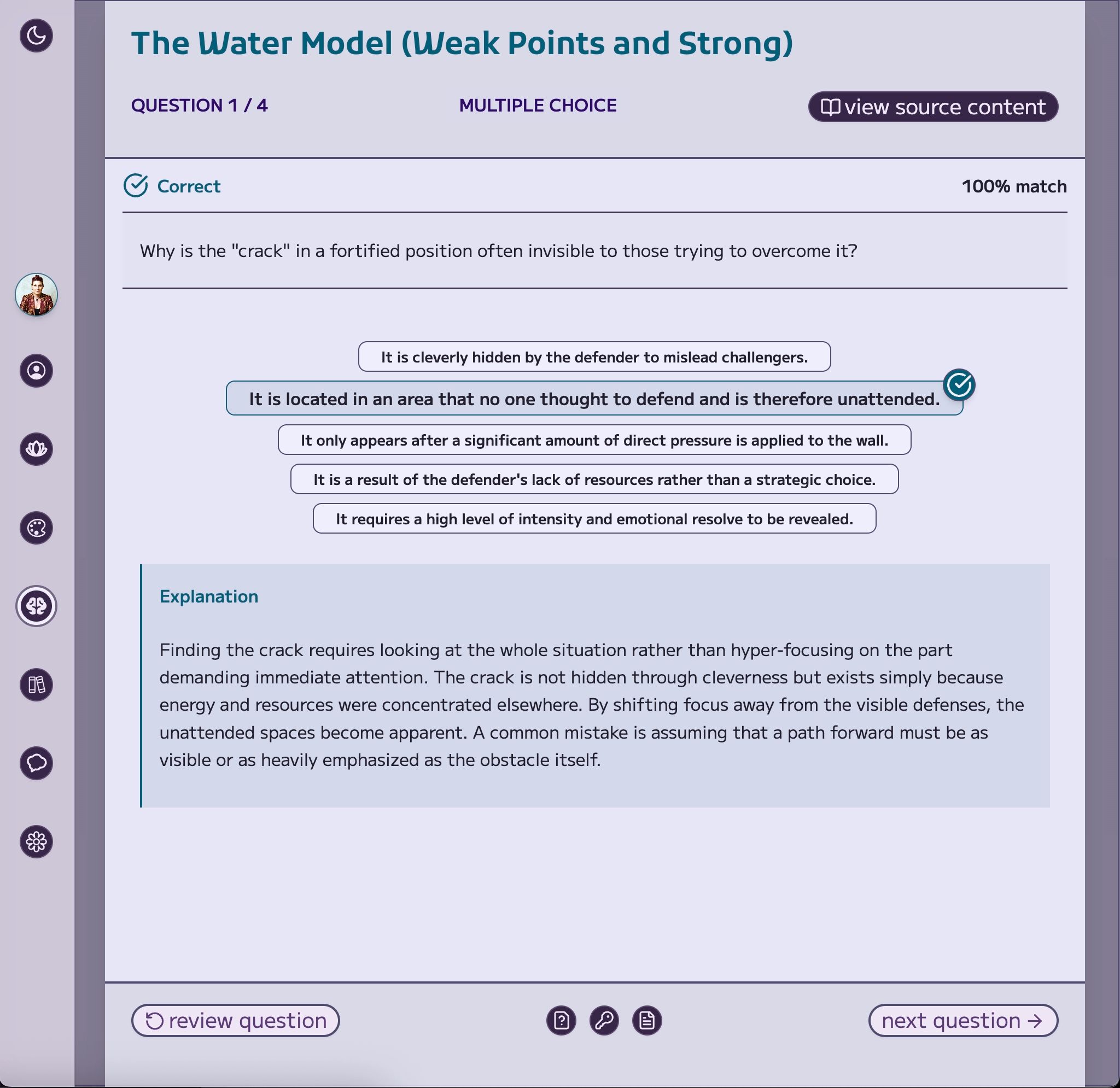
So the demo generates every question, answer, and explanation from your source and nothing else, then lays your original material out as a clean reading you can open at any point. When a question stumps you, the source is right there. The explanation tells you why an answer is correct by pointing back at the text, rather than improvising. When you finish, you can review the whole set and download a PDF record to keep. This same grounding is the rule inside Lumi Forge, where the value always comes from engaging with the creator's actual ideas.
The Gift of Being Wrong
Somewhere along the way, most of us learned to treat a wrong answer as a small humiliation. I would love to gently undo that. A wrong answer, examined honestly, is one of the most useful things that can happen while you learn. It shows you exactly where your understanding bends, which is the only place real repair can start.
When you miss a question in the demo and read the grounded explanation, that little jolt of "oh, that is why" is the repair happening in real time. Lumi Forge takes the same stance and builds a whole economy around it. Every interaction earns experience points, and you earn them for wrestling with a hard concept and getting it wrong just as much as for getting it right, because comprehension lives in the grappling. I have come to think of being wrong as an invitation rather than a flaw, and a tool that rewards the effort instead of only the perfect score quietly gives you permission to take intellectual risks.
Made to Be Printed and Shared
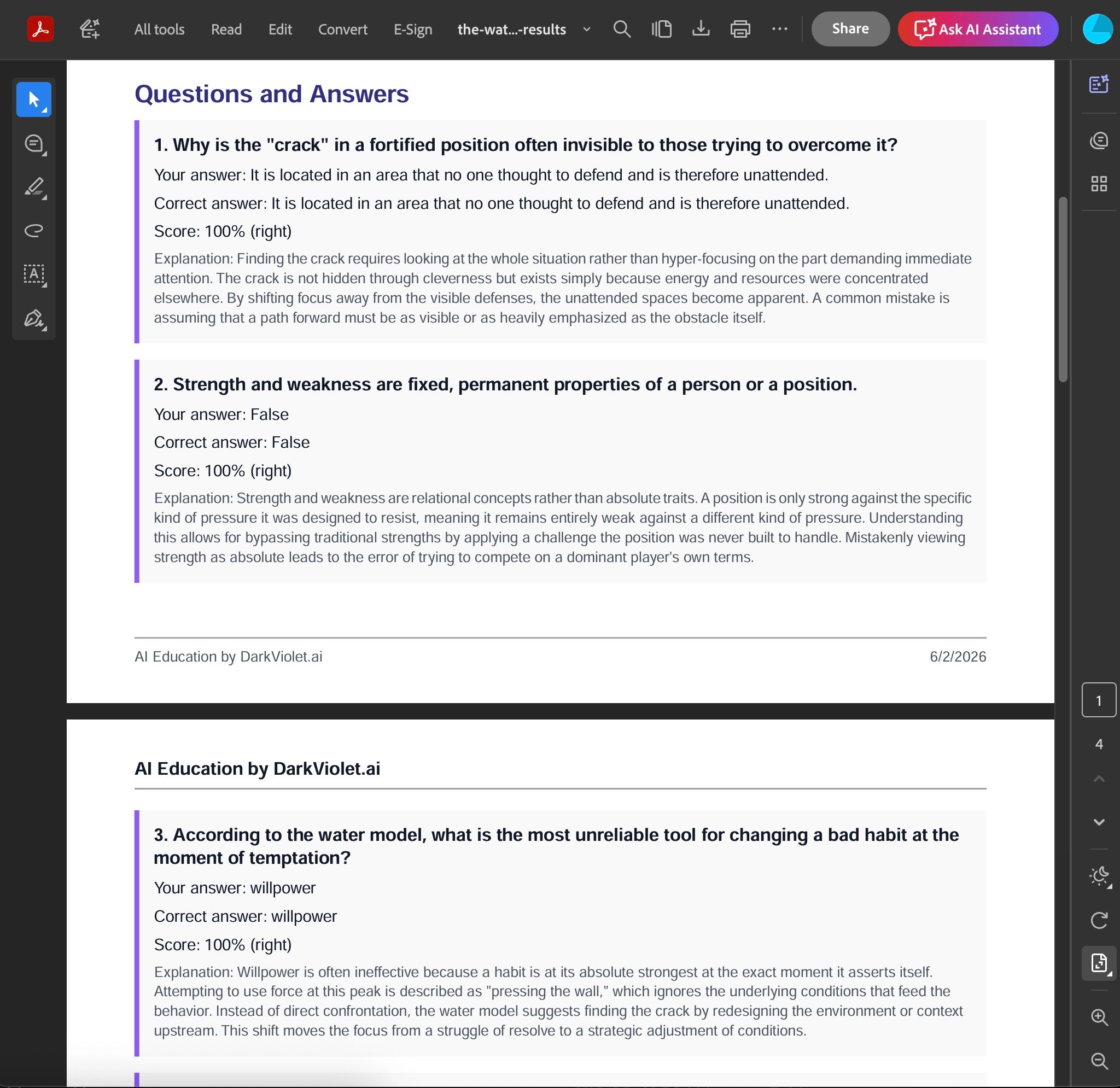
Here is a part I did not expect to care about as much as I do, something I just tacked on at the end of creating our AI for Learning demo. When the questions are ready, the demo does not keep them locked inside the browser. You can print the whole exercise as a PDF in four different shapes: the completed set with every answer and explanation in place, a blank worksheet with just the questions, a separate answer key, and the formatted original content laid out as a clean reading on its own.
The flexibility is the point, because it hands the decision back to you. A teacher can generate a worksheet and an answer key from their own material in a single pass, print a stack, and walk into class without losing an evening to writing questions by hand. A learner can print the blank version, close the laptop, and work through it with a pen, which is its own kind of focus. You can keep the formatted reading as a tidy study copy and save the completed set to review later. The AI handles the tedious building and formatting, and you decide how the learning actually happens, whether you are teaching someone else or teaching yourself. That is amplification in the plainest terms I know.
Scaling Up
The demo is one small slice. Lumi Forge is where these ideas stretch out to full size, and it is built as much for the people who teach as for the people who learn. A creator brings a single body of work, whether a PDF, a transcript, or a lifetime of notes, and the platform's human-centered AI helps shape it into something interactive without making them rebuild from scratch. From one section of writing, it can generate a polished interactive lesson, dozens of small checkpoints, content for five different learning games, and a few swipeable micro-lessons, all in minutes.
For the learner, one of the parts I love most is the companion panel that sits beside the reading. It knows the specific material you are in, so when a framing is not landing, you can ask it to explain the idea another way, right when the question is fresh. There is no judgment in it and no sigh. It meets each of us where we are, letting the person who knows the basics move fast and the one who feels lost slow down and dig in. A static page has never been able to do that.
Becoming More Human
When I reduce all of this down to its essence, the same quiet idea is sitting underneath, the part that motivates me to keep working so hard to amplify the human experience of knowledge-building. The most exciting thing about AI in learning is how much more human it can let us be. It can take the tedious parts off our plates and allow us to focus on the best parts: the curiosity, the struggle, the slow satisfaction of finally understanding, and the joy of helping someone else get there too.
I am still working this out, like everyone else. But here is what I have noticed so far. When we ask AI to do our thinking, we end up a little smaller, blander, and maybe even dumber. When we ask it to amplify our thinking, we end up sharper, and so do the people we teach. That is the whole bet behind AI for Learning, and you are welcome to test it yourself. The little demo lives on DarkViolet.ai, and the fuller experience lives at LumiForge.io. I would genuinely love to know what you find.